
As a student in busy places like the United States, Canada, or the United Kingdom, you face endless tasks. From homework to exams, sports, and part-time jobs, it all adds up. That’s why understanding which of the following can be considered an important part of time management matters so much. It helps you stay on top of things without feeling overwhelmed. In this guide, we’ll break it down simply, using real examples from school life. We’ll draw from trusted sources to show you how to build strong habits that lead to success in your studies and beyond.

Time management isn’t just about clocks or calendars. It’s a set of time management skills that let you use your hours wisely. Think about a typical day: You wake up, go to class, study, and maybe hang out with friends. Without a plan, you might rush through assignments or forget quizzes. But with good strategies, you finish everything on time and even have free moments. Studies show that students who manage time well get higher grades and feel less stressed. For example, a report from educational experts notes that planning ahead cuts procrastination by up to 50%.
Let’s start by looking at a common question many students ask.
Understanding Time Management Basics
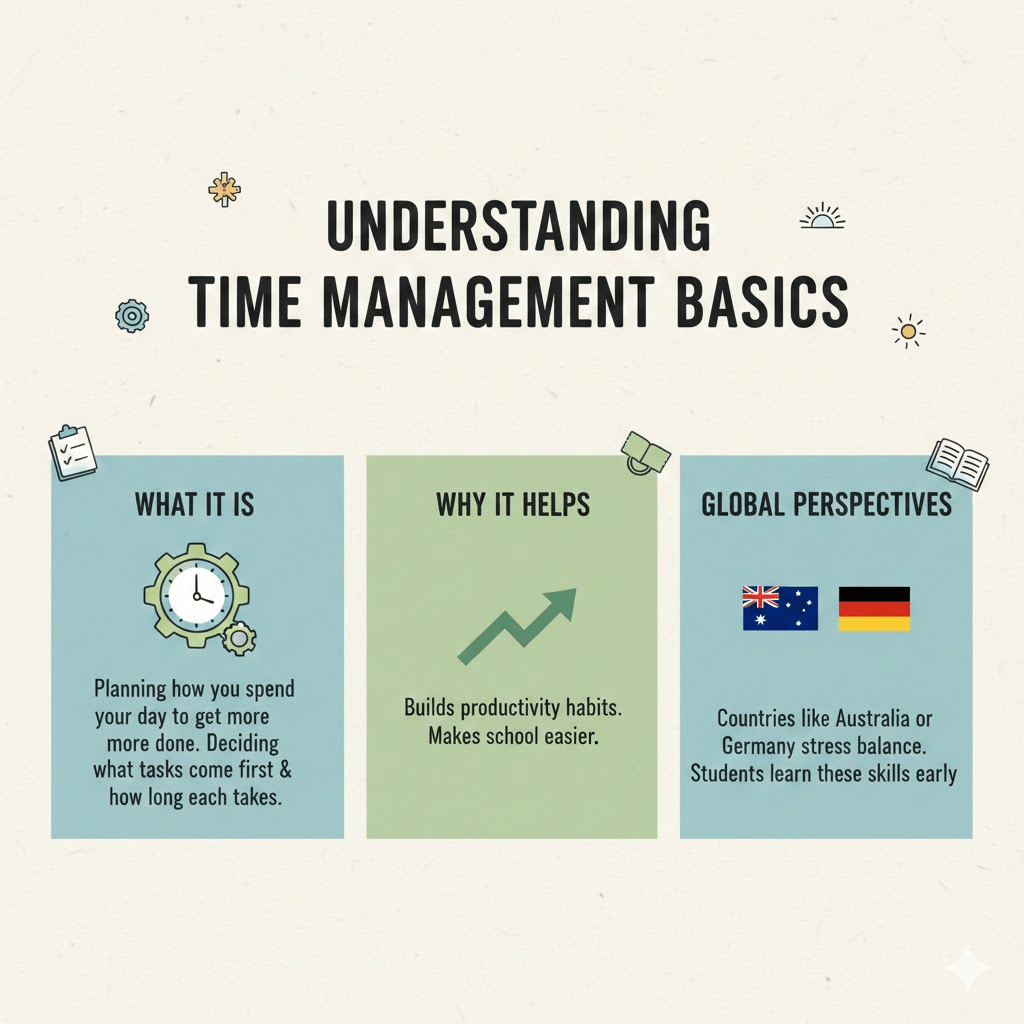
Time management means planning how you spend your day to get more done. It includes deciding what tasks come first and how long each takes. Why does this help? It builds productivity habits that make school easier. In countries like Australia or Germany, where school systems stress balance, students learn these skills early.
Key benefits include:
- Less stress from last-minute work.
- More time for fun activities.
- Better focus on goals, like acing a test.
To grasp this, consider your own routine. Do you ever feel like there’s not enough time? That’s where effective planning steps in. It turns chaos into order.
Which of the Following Can Be Considered an Important Part of Time Management?
Now, let’s tackle the main question: Which of the following can be considered an important part of time management? Imagine this multiple-choice setup, based on real student advice from online study guides.
Options might look like:
- A. Keeping papers in a binder with dividers for each class.
- B. Highlighting times on a calendar.
- C. Timing how long it takes to complete assignments and quizzes.
- D. Thinking about how much time to spend on each task and in what order they should be done.
The best answer is D. Why? Because task prioritization and deciding time for each job form the core of managing your day. Options A, B, and C are helpful tools, but they support the bigger idea in D. This involves assessing what you need to do, estimating effort, and sequencing tasks by importance.
For instance, if you have math homework due tomorrow and a history project next week, you prioritize math first. You think: “Math takes two hours; I’ll do it after school.” This planning ahead prevents overload. In student forums, many agree that without this step, other organization tricks fall short.
Why Task Prioritization Stands Out
Task prioritization is a top time-management strategy. It means ranking jobs by urgency and value. Urgent tasks have deadlines soon, like a quiz tomorrow. Important ones tie to big goals, like studying for finals.
How to do it:
- List all tasks for the day or week.
- Mark them as high, medium, or low priority.
- Start with high ones to build momentum.
This skill boosts work efficiency1. A study guide for careers highlights that prioritization helps reach long-term aims by focusing on key steps first. For students in Tier 1 countries like the US, where college prep is intense, this means better SAT scores or scholarship chances.
Compare it to business: Entrepreneurs use similar methods to grow startups. Check out how to build a startup with no money for ideas on applying prioritization in real life.
Building Effective Scheduling Habits
Once you prioritize, scheduling tasks comes next. This is about putting jobs into time slots. Use a planner or app to map your day.
Simple steps:
- Wake up and review your list.
- Block time for classes, study, breaks, and meals.
- Include buffers for surprises, like a friend calling.
Tools help here. Apps like Google Calendar or Todoist make it easy. In places like France or Japan, students use digital planners to balance school and hobbies. This leads to work-life balance, keeping you healthy and happy.
For example, if you’re a college student in Canada, schedule study groups around lectures. This time allocation ensures you don’t overcommit.
Relate it to future careers: Learn about what is marketing and how does it help a business to see how scheduling drives success.
Organizing Tasks for Better Flow
Organizing tasks supports time management. Keep notes, books, and files in order. Use binders with dividers for classes, as in option A above.
Why it matters:
- Saves time hunting for papers.
- Reduces mental clutter.
- Builds routine building.
In school, this means a backpack setup with sections for math, English, and science. Digital tools like OneNote help too. Students in the UK often use color-coded systems for exams.
Tie this to broader skills: For aspiring business owners, organization is key. Explore how to start a small business for tips.
Minimizing Distractions and Tracking Time
Distractions steal time. Phones, social media, or TV pull focus. To fight this, use techniques like the Pomodoro method: Work 25 minutes, break 5.
Minimizing distractions tips:
- Set phone to silent during study.
- Use apps to block sites.
- Study in quiet spots.
Time tracking means noting how long tasks take. This refines estimates. If homework usually takes an hour but runs to two, adjust next time.
In Tier 2 countries like India or Brazil, students use free apps for this. It improves time estimation.
For productivity boosts, see best AI tools for small business productivity – adaptable for students.
Goal Setting and Time Management
Goal setting links to time management. Set SMART goals: Specific, Measurable, Achievable, Relevant, Time-bound2.
Examples for students:
- “Finish math assignment by 5 PM today.”
- “Study two hours daily for finals next month.”
This daily planning keeps you on track. Career guides stress it for academic wins.
In the US, colleges teach this in orientations. It prepares for jobs where time matters, like in startup funding options for first-time entrepreneurs.
Managing Deadlines and Workflow
Managing deadlines avoids cramming. Break big projects into small steps with mini-deadlines.
Organizing workflow means sequencing tasks logically. Do easy ones first for quick wins, then tackle hard ones.
This task sequencing flows naturally. For quizzes, review notes a day before.
Articles on learning emphasize adapting plans as needed. In Australia, students use this for group projects.
Business parallel: See lean startup strategy examples for beginners.
Productivity Skills for Students
Build productivity skills with habits. Sleep well, eat healthy, exercise. These fuel focus.
Use rewards: After studying, watch a show.
In Germany, schools promote breaks for efficiency. This ties to time-management strategies like buffering time.
For more, check how to manage cash flow in a small business – similar to managing study time.
Tools for Time Management
Scheduling tools like calendars and planners are game-changers. Physical notebooks work for some; apps for others.
Popular ones:
- Forest app for focus.
- Trello for task boards.
In Canada, many use these for online classes. They help with study schedules.
Entrepreneur tip: Best business phone systems for small businesses in 2025.
Overcoming Common Challenges
Students face hurdles like procrastination. Beat it by starting small.
Another: Overloading schedules. Learn to say no.
In the UK, counseling helps with this. Build productivity habits gradually.
For inspiration, read young entrepreneurs success stories to inspire students.
Time Management in College and Beyond
As you move to college in places like the US or France, time management evolves. Handle more freedom with stronger plans.
It preps for careers. Many jobs value these skills.
Explore entrepreneurship skills every beginner should learn.
Faqs
What role does prioritization play in time management?
Prioritization helps you identify high-impact tasks that align with your goals, ensuring you focus energy on what truly matters to avoid wasting time on less important activities. By ranking tasks based on urgency and importance, it creates a clear roadmap, reducing decision fatigue and increasing overall efficiency in daily routines.
How does goal setting enhance time management?
Goal setting provides specific, measurable targets that guide your actions, making it easier to allocate time effectively and track progress toward achievements. It fosters motivation and accountability, as breaking down long-term objectives into short-term steps prevents overwhelm and promotes consistent productivity.
Why is minimizing distractions crucial for time management?
Minimizing distractions preserves focus by creating an environment conducive to deep work, allowing you to complete tasks faster and with higher quality. It builds mental resilience over time, as habits like setting boundaries with technology lead to sustained concentration and better work-life balance.
How can time tracking improve your time management skills?
Time tracking reveals patterns in how you spend your hours, highlighting inefficiencies and enabling data-driven adjustments to your schedule for optimal use. It cultivates self-awareness and discipline, turning vague perceptions of time into precise insights that support smarter planning and habit formation.
Conclusion
In summary, which of the following can be considered an important part of time management? It’s thinking about time per task and their order – the heart of prioritization and planning. By using time management skills, task prioritization, effective planning, scheduling tasks, productivity skills, time allocation, organizing tasks, setting priorities, daily planning, and time-management strategies, you can master your days. Add managing deadlines, work efficiency, goal setting, time estimation, planning ahead, organizing workflow, minimizing distractions, task sequencing, time tracking, work3-life balance, study schedules, routine building, productivity habits, and scheduling tools for full success. These reduce stress and boost grades.
What time management tip will you try first to improve your student life?
References
- Coursera: Article on time management strategies, aimed at learners building skills for education and work. https://www.coursera.org/articles/time-management ↩︎
- Quizlet: Flashcards on career study guides, focusing on goal-setting and prioritization for academic and professional growth. https://quizlet.com/561972351/career-study-guide-modules-1-2-flash-cards/ ↩︎
- Brainly: A student question on time management elements, targeting school learners with examples like assignments and quizzes. https://brainly.com/question/15790984 ↩︎

