
When a hurricane hits, a ransomware attack locks your servers, or a power outage lasts days, every minute costs money. Leaders often ask the same question: difference between disaster recovery and business continuity planning? The short answer is simple: Business Continuity Planning (BCP) keeps the entire company alive during and after a crisis, while Disaster Recovery Planning (DRP) focuses on getting computers, applications, and data back online quickly. One is about the whole business; the other is mainly about IT.
Many executives mix the two up, and that mistake can cost millions. This guide clears the confusion with plain and simple, so business owners, managers, and IT teams know exactly what each plan does and why you need both.How to Write a Business Plan (step-by-step) → how-to-write-a-business-plan
What Is Business Continuity Planning (BCP)?
Business continuity planning is the big-picture strategy that makes sure your company can keep serving customers no matter what happens. It covers people, processes, facilities, suppliers — everything needed to stay in business.
Think of BCP as the playbook that answers: “How do we keep money coming in even if the office burns down or half the staff can’t get to work?”
Key parts of a good BCP:
- Business impact analysis (BIA) – finds the most important functions
- Alternate work sites or remote-work rules
- Crisis communication plans (who tells customers, staff, regulators?)
- Supplier and partner backup plans
- Manual work-arounds when systems are down
Real-world example: When floods hit Thailand in 2011, Toyota lost parts suppliers and had to stop car production worldwide. Companies with strong business continuity planning switched to backup suppliers in days instead of months.
What Is Disaster Recovery Planning (DRP)?
Disaster recovery plan is the IT-focused part. Its only job is to restore technology — servers, networks, phones, software, and data — as fast as possible after a disruption.
DR is measured by two magic numbers every IT team knows:
- Recovery Time Objective (RTO) – How many minutes or hours can we be down before the business gets seriously hurt?
- Recovery Point Objective (RPO) – How much data can we afford to lose (seconds, minutes, hours)?
Example: A bank might say “RTO = 4 hours, RPO = 5 minutes” for online banking. That means customer accounts must be back in 4 hours and lose no more than 5 minutes of transactions.
Common disaster recovery procedures:
- Off-site or cloud backups
- Failover to secondary data centers
- Virtual machine snapshots
- Cloud-based disaster recovery
Difference Between Disaster Recovery and Business Continuity Planning – Side-by-Side Comparison
| Question | Business Continuity Planning (BCP) | Disaster Recovery Planning (DRP) |
| Main focus | Keep the whole company running | Get IT systems and data back online |
| Scope | Company-wide (people, processes, locations) | Mostly IT and data centers |
| Goal | Minimal disruption to customers and revenue | Minimal downtime for technology |
| Key question | “How do we keep operating?” | “How do we restore technology?” |
| Typical owner | Risk manager or operations leader | IT director or cloud architect |
| Includes manual processes? | Yes | No – only technology |
| Standards | ISO 22301, BCI Good Practice Guidelines | ISO 27031, NIST 800-34 |
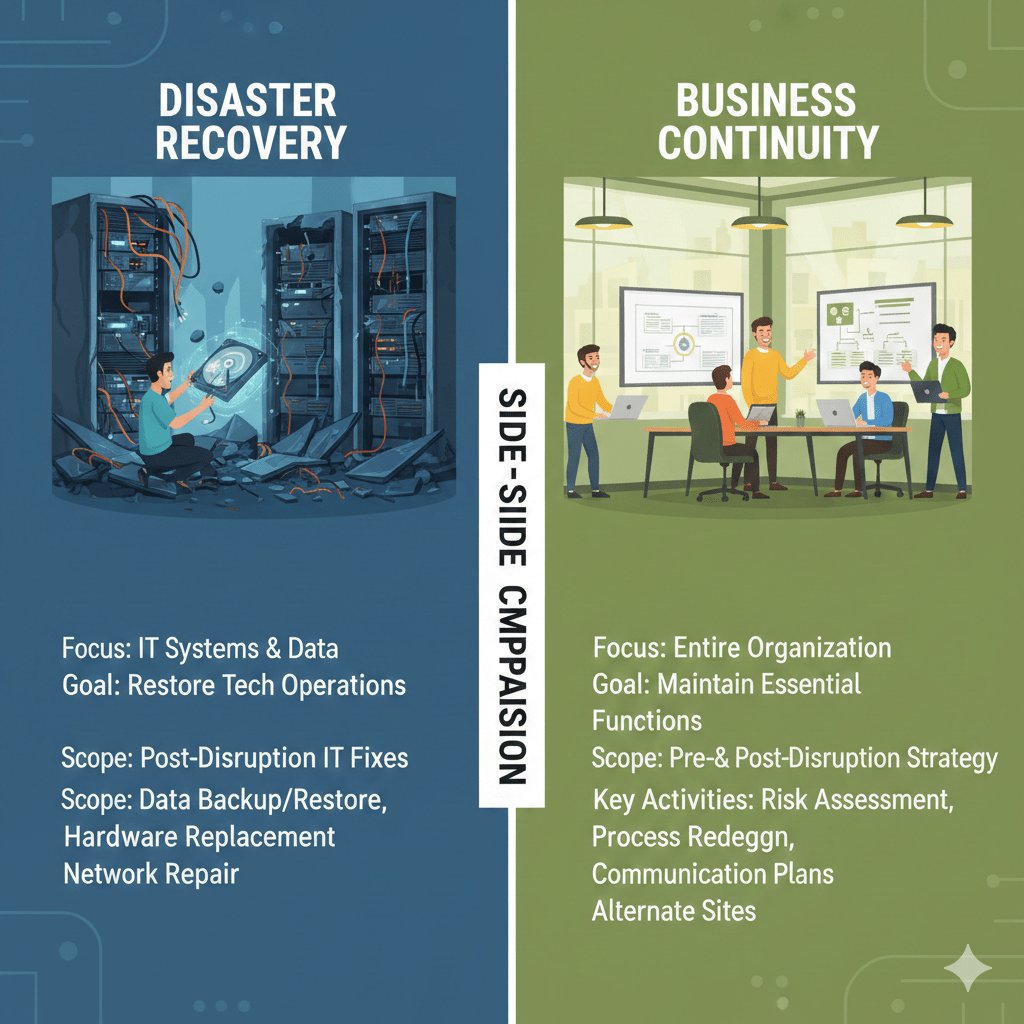
This table shows why BCP vs DRP is not an either/or choice — they work together like a heart (BCP) and lungs (DR) of organizational survival.
Why Companies Need Both BCP and DR Plans
Gartner says companies without solid plans lose an average of $5,600 per minute during major outages. Yet only 54% of organizations have a full enterprise resilience planning program that joins BCP and DR.
Real examples:
- Target’s 2013 data breach – DR team restored systems fast, but weak business continuity planning meant stores couldn’t process credit cards for hours → $290 million loss.
- Maersk’s 2017 NotPetya attack – Great DR brought servers back in 10 days, but missing pieces in BCP cost $300 million because shipping terminals stayed closed.
Having both plans cuts financial risk, protects reputation, and often lowers insurance premiums.
How Disaster Recovery Supports Business Continuity
Most experts now say disaster recovery vs business continuity plan is the wrong question. The right view: How disaster recovery supports business continuity.
Picture it like this:
- Disaster strikes → IT systems crash
- DR plan kicks in → restores servers and data
- BCP takes over → employees use restored systems (or manual processes) to keep serving customers
Without DR, BCP fails. Without BCP, even perfect DR leaves the company paralyzed because people don’t know what to do next.
Key Steps to Build Strong BC and DR Plans
Step 1 – Do a Business Impact Analysis (BIA)
List every process and ask: “If this stops for 1 hour, 1 day, 1 week — how much money and reputation do we lose?”
Step 2 – Set RTO and RPO for Every System
- Email might have RTO = 4 hours, RPO = 1 hour
- Payroll system might have RTO = 48 hours, RPO = 1 week
Step 3 – Choose Recovery Strategies
- Cloud backups and failover (fast and popular in 2025)
- Hot sites, warm sites, or cold sites
- Work-from-home policies and laptop programs
Step 4 – Write Clear Playbooks
Who calls whom? Where do people work? How do we pay suppliers if accounting software is down1?
Step 5 – Test, Test, Test
Run tabletop exercises and real fail-over tests twice a year. Companies that test regularly recover 50% faster (IBM study).
Common Myths – Busted
| Myth | Truth |
| “Cloud means we don’t need DR” | Wrong. Cloud regions can fail. You still need backups and failover plans. |
| “Only big companies need BCP” | Small businesses close forever 40% of the time after major disasters. |
| “Insurance covers everything” | Insurance pays money later. BCP and DR keep cash flowing right away. |
Trends in BC/DR Planning

- 83% of companies now use cloud-based disaster recovery (Flexera 2025 report)
- AI predicts outages before they happen and starts failover automatically
- Zero-trust security is built into every IT infrastructure continuity plan
- Remote and hybrid work means BCP now includes home internet and laptop backup plans
Quick Checklist – Do You Have Both Plans?
- We have a written business continuity plan updated in the last 12 months
- We know our RTO and RPO for every critical system
- We test failover at least once a year
- Employees know where to go and what to do if the office is unreachable
- We have off-site or cloud backups tested monthly
- Startup Funding Options for First-Time Entrepreneurs → startup-funding-options-for-first-time-entrepreneurs/
If you answered “no” to any of these, it’s time to act.
FAQs – Fast Answers
What is the main difference between disaster recovery and business continuity planning?
Business continuity planning (BCP) keeps the entire company running during and after a crisis (people, customers, sales, suppliers).
Disaster recovery (DR) only brings the IT systems and data back online.
→ BCP = “keep making money.” DR = “get the computers working again.”
Is disaster recovery part of business continuity?
Yes. Almost every modern standard (ISO 22301, NIST, IBM, etc.) says disaster recovery is a subset (one important piece) of the bigger business continuity program.
Business continuity vs disaster recovery – do I really need both?
Yes. If you only have DR, your servers will come back, but your team won’t know where to work or how to take orders.
If you only have BCP, you’ll have manual work-arounds, but you’ll lose days or weeks of data and modern tools. Companies with both recover 50–70 % faster and lose far less money.
What is the difference between BCP and DRP?
- BCP = Business Continuity Plan → company-wide playbook
- DRP = Disaster Recovery Plan → IT-only playbook Same idea as above, just the short acronym version.
Who is responsible for each plan?
- Business Continuity Planning → usually owned by Risk Management, Operations, or a Chief Resilience Officer
- Disaster Recovery Planning → usually owned by IT / Cybersecurity / Cloud team In small companies, one person can wear both hats.
In Conclusion – Protect Your Future Today
Understanding the difference between disaster recovery and business continuity planning is the first step to real protection. Disaster recovery gets your computers running again. Business continuity makes sure your people can use those computers to keep money coming in and customers happy. Smart companies treat them as partners, not competitors.
Start small: run a one-day workshop2, list your top five critical processes, and set realistic RTOs and RPOs. One afternoon of planning today can save millions tomorrow.
Which one worries you more right now — losing your data or losing your ability to serve customers? Drop your answer in the comments and let’s talk.
References & Trusted Sources
- BCM Institute – “What Is the Difference Between IT Disaster Recovery and Business Continuity” blog.bcm-institute.org/it-disaster-recovery/what-is-the-difference-between-disaster-recovery-and-business-continuity → Deep, standards-based explanation perfect for certification students and risk managers. ↩︎
- IBM – “Business Continuity vs. Disaster Recovery Plan” ibm.com/think/topics/business-continuity-vs-disaster-recovery-plan → Excellent strategic overview loved by executives and boards. ↩︎

