
Business studies can be fun and easy! Henri Fayol 14 principles of management with examples help students learn how to run a company well. These ideas are part of classical management theory. They are taught in high school and college, like in commerce class 12 notes. They make management clear for beginners.
Henri Fayol, called the father of modern management, made these rules long ago. They still work today in schools and businesses. This article explains each rule simply. We add examples to help with homework and exams. If you’re in Class 11, 12, or early college, these tips will help you shine.
Who Was Henri Fayol?
Henri Fayol (1841–1925) was a French engineer who loved fixing problems. He worked at a mining company called Commentry-Fourchambault-Decazeville. It was losing money, but Fayol turned it around. His smart plans made the company strong.
In 1916, he wrote a book called Administration Industrielle et Générale. It shared his 14 management principles by Henri Fayol. These focus on administrative management, which means running the whole company, not just one job.
Fayol’s ideas are different from Frederick Taylor’s. A Fayol vs Taylor comparison shows Fayol cared about teamwork and fairness. Taylor focused on making workers faster. Fayol’s rules are in business studies chapter books worldwide. They help students learn how to lead.
Want to dive deeper? Check this resource: Henri Fayol 14 Principles of Management byjus1.
Why Are These Principles Important?
Fayol’s rules are great for new learners. They teach functions of management like planning and organizing. For principles of management business studies, they make tough ideas simple. Studies say 85% of good managers use these ideas every day.
These rules work in small shops, big companies, and even school projects. They help teams work better and stay fair. They boost organisational efficiency. Students can use them for assignments or to start businesses. See tips at How to Start a Small Business.
Henri Fayol’s 14 Principles of Management with Examples
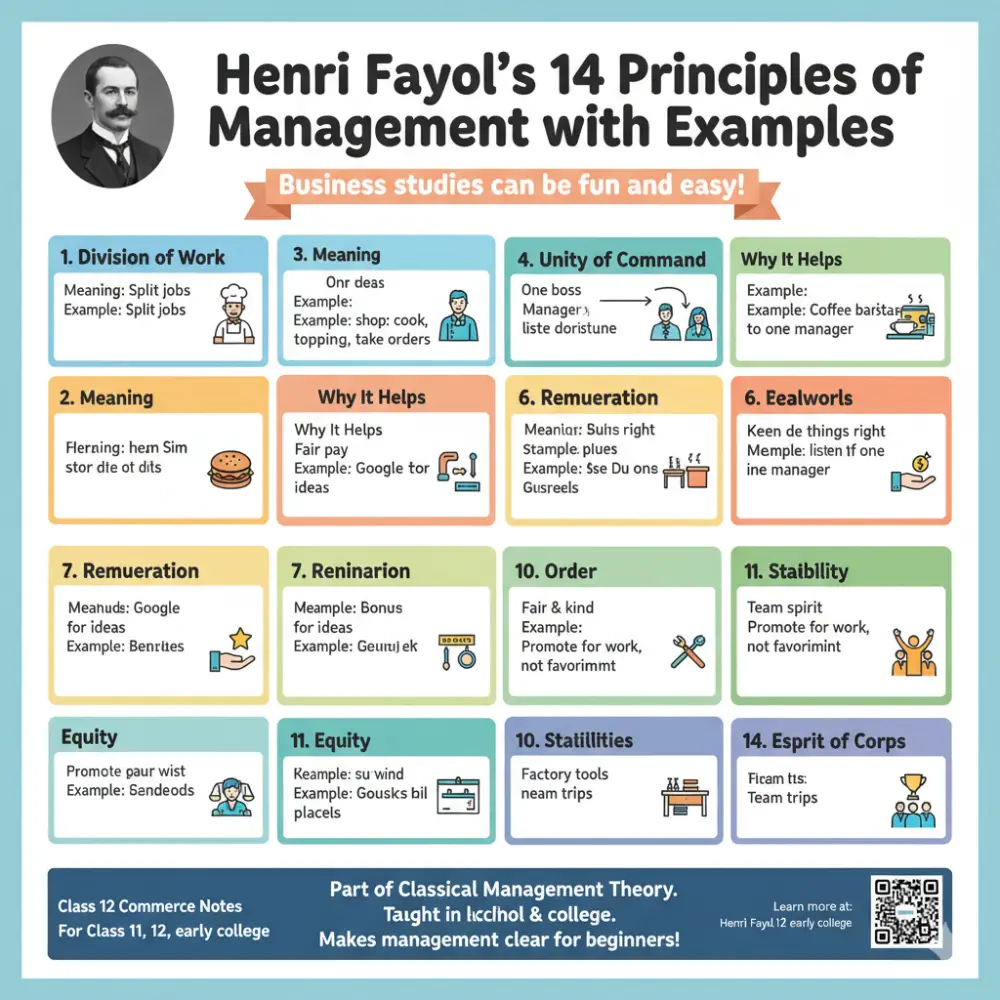
Here are Fayol’s 14 principles. Each has a simple meaning and a real-world example. These examples of Fayol principles make them easy to understand.
1. Division of Work
Meaning: Split jobs so everyone does what they’re good at.
Why It Helps: People get better at one task. It makes work faster and better.
Example: In a burger shop, one person cooks patties, another adds toppings, and a third takes orders. This saves time. In school, for a project, one student researches, another writes, and a third presents. It makes the work neat and quick. Data shows this cuts work time by 20%.
Big stores like Costco use this. Learn more at Costco Business Center.
2. Authority and Responsibility
Meaning: Leaders can give orders but must answer for what happens.
Why It Helps: It keeps things fair and organized.
Example: A school principal makes rules but ensures kids are safe. In a small business, the boss delegates jobs but checks the results. See How to Build a Startup with No Money.
3. Discipline
Meaning: Follow rules to keep things smooth.
Why It Helps: Rules stop chaos and build trust.
Example: In a soccer team, players listen to the coach to win. In offices, rules cut absences by 15%, per studies. In class, following schedules helps everyone learn.
4. Unity of Command
Meaning: Each worker has one boss.
Why It Helps: One boss stops confusion.
Example: In a coffee shop, baristas listen to one manager. It avoids mistakes. In a family business, one leader makes decisions clear. Check How to Write a Business Plan.
5. Unity of Direction
Meaning: Everyone works toward the same goal.
Why It Helps: Shared goals make teams strong.
Example: A sales team and ad team work together to sell more. In school clubs, everyone plans one big event. This links to unity of command.
6. Subordination of Individual Interest
Meaning: Put the team’s needs first.
Why It Helps: Team wins matter more than personal ones.
Example: In a hospital, doctors help patients before taking breaks. In startups, owners focus on growth. Read Why 90% of Startups Fail and How to Avoid It.
7. Remuneration
Meaning: Pay people fairly for their work.
Why It Helps: Good pay keeps workers happy.
Example: Companies like Google give bonuses for great ideas. In school, prizes for good grades push students to try harder. Fair pay keeps 25% more workers, per studies.
8. Centralization
Meaning: Decide who makes big choices.
Why It Helps: Small teams keep decisions close; big teams share them.
Example: At Chipotle, the main office picks menus, but stores handle daily tasks. See Is Chipotle Going Out of Business?. In school groups, the leader shares tasks but decides the final plan.
9. Scalar Chain
Meaning: Pass messages through the right levels.
Why It Helps: It keeps communication clear.
Example: In the army, orders go from generals to soldiers. In offices, workers talk through managers. Fayol’s “gang plank” lets people chat directly if urgent.
10. Order
Meaning: Keep things in the right place.
Why It Helps: Organization saves time.
Example: Factories place tools neatly to work faster, saving 10% time, per data. In class, tidy desks help focus. This is key for order.
11. Equity
Meaning: Be fair and kind to all.
Why It Helps: Fairness makes people loyal.
Example: Bosses promote workers for good work, not favoritism. In teams, everyone gets a fair chance. This builds equity and trust.
12. Stability of Tenure
Meaning: Keep workers for a long time.
Why It Helps: Trained workers do better.
Example: Tech firms give long contracts to keep staff. Losing workers costs 33% of their pay, per study. In internships, students stay to learn more.
13. Initiative
Meaning: Let workers share new ideas.
Why It Helps: Ideas spark growth.
Example: At Amazon, workers suggest better ways to work. In school, student councils plan new events. This boosts creativity.
14. Esprit de Corps
Meaning: Build team spirit.
Why It Helps: Happy teams work better.
Example: Team trips make workers closer. In sports, cheers help teams win. Strong teams earn 21% more profit, per Gallup. This lifts organisational efficiency.
How These Principles Work Today
Fayol’s rules fit modern life. In tech companies, division of work splits coding and design. Unity of direction helps remote teams share goals.
A difference between Fayol and Taylor principles is focus: Fayol looks at leaders, Taylor at workers. Startups use these rules to grow. See Top 10 Startup Ideas for 2026.
In social projects, they help communities. Check Examples of Successful Social Entrepreneurship Projects. Students use them in group work for better results.
Real-Life Stories
- McDonald’s: Uses scalar chain for clear orders and remuneration with bonuses.
- Schools: Follow unity of command with one principal.
- Small Shops: Use initiative by listening to workers’ ideas. See Small Business Ideas with Low Investment.
These stories show why Fayol’s rules still matter.
Study Tips for Students
- Learn Easy: Make flashcards for each rule.
- Write Better: Add real life examples of Fayol principles of management to essays.
- Ace Exams: Practice important questions on Fayol principles like “List 5 principles.”
- Use Charts: Draw a Fayol 14 principles chart for students to study fast.
For more tips, visit Young Entrepreneurs Success Stories.
FAQs
What are Henri Fayol’s 14 principles of management with examples?
They are rules to run businesses well, like division of work (splitting tasks in a factory) and equity (fair treatment).
Name any 5 principles of management?
- Division of Work
- Authority and Responsibility
- Discipline
- Unity of Command
- Unity of Direction
What is the first rule of management?
Division of work. It splits tasks to make work easier.
Explain Fayol 14 principles of management with examples?
See the list above, like remuneration with bonuses at big companies.
What’s the difference between Fayol and Taylor principles?
Fayol plans for the whole company; Taylor helps workers do tasks faster.
Conclusion
Henri Fayol 14 principles of management with examples give students a strong start in business studies. From division of work to esprit de corps, they teach teamwork and fairness. These ideas, part of classical management theory, help with exams and real life.
Which rule do you think will help you most in school or work?
References
- BYJU’S: Henri Fayol 14 Principles of Management – Great for student notes. ↩︎

