
Every business faces risks — from cyberattacks and power outages to natural disasters and supply-chain breakdowns. A strong business continuity plan (BCP) keeps your company running when trouble hits. But a plan that sits on a shelf is worthless. The key question every risk manager, IT leader, and executive asks is simple: how often should a business continuity plan be tested?

The short answer: at least once a year — and always after any major change. The real answer depends on your industry, size, risk level, and regulations. This guide gives you clear, practical schedules, proven testing types, and easy steps so your organization stays truly prepared.• Best Business Phone Systems for Small Businesses
Why Testing Your BCP Is Non-Negotiable
An untested plan is like an untested parachute — you only discover the holes when you jump. Regular business continuity plan exercises find gaps before a crisis does. Studies show:
- 51% of companies that experience a major disruption without a tested BCP go out of business within two years (source: FEMA).
- Organizations that test regularly recover 3–5 times faster (Gartner).
- 93% of businesses that lose their data center for 10+ days file for bankruptcy within one year (U.S. National Archives).
Testing proves your plan works, trains your people, and satisfies auditors. It is the heartbeat of BCP maintenance and testing.
Recommended Business Continuity Plan Testing Frequency
There is no single magic number, but global standards and experts agree on these baselines:
| Testing Type | Recommended Frequency | Who Recommends It |
| Full plan review & document update | At least annually after major changes | ISO 22301, NIST, FFIEC, LogicManager |
| Tabletop exercise / walkthrough | Every 6–12 months | DataGuard, Arcserve |
| Functional / component test | Twice per year | Arcserve, DRI International |
| Full-scale simulation / live drill | Every 2–3 years (or annually for high-risk) | Arcserve, ISO 22301 high-maturity level |
| Checklist or simple validation | Quarterly or semi-annually | Most compliance frameworks |
Always trigger an extra test or review when:
- You add new technology or locations
- Staff turnover affects key roles
- You experience a near-miss incident
- Regulations change (GDPR, HIPAA, SOX, etc.)
- Mergers, acquisitions, or major vendor changes happen
This approach matches BCP review and update frequency best practices used by Fortune 500 companies and regulators worldwide.• How to Write a Business Plan
How Often Should a Business Continuity Plan Be Tested by Industry?
Different risks mean different cadences:
| Industry | Minimum Testing Frequency | Main Driver |
| Financial Services / Banking | Quarterly functional + annual full test | FFIEC, FDIC, Basel III |
| Healthcare | Semi-annual + after any system change | HIPAA, Joint Commission |
| Manufacturing | Annual full + quarterly component tests | Supply-chain complexity |
| Retail / E-commerce | Annual + after peak-season changes | Revenue protection |
| Government / Public Sector | Annual + tabletop every 6 months | NIST 800-34, state requirements |
| Critical Infrastructure | Quarterly or more | NERC CIP, CISA guidelines |
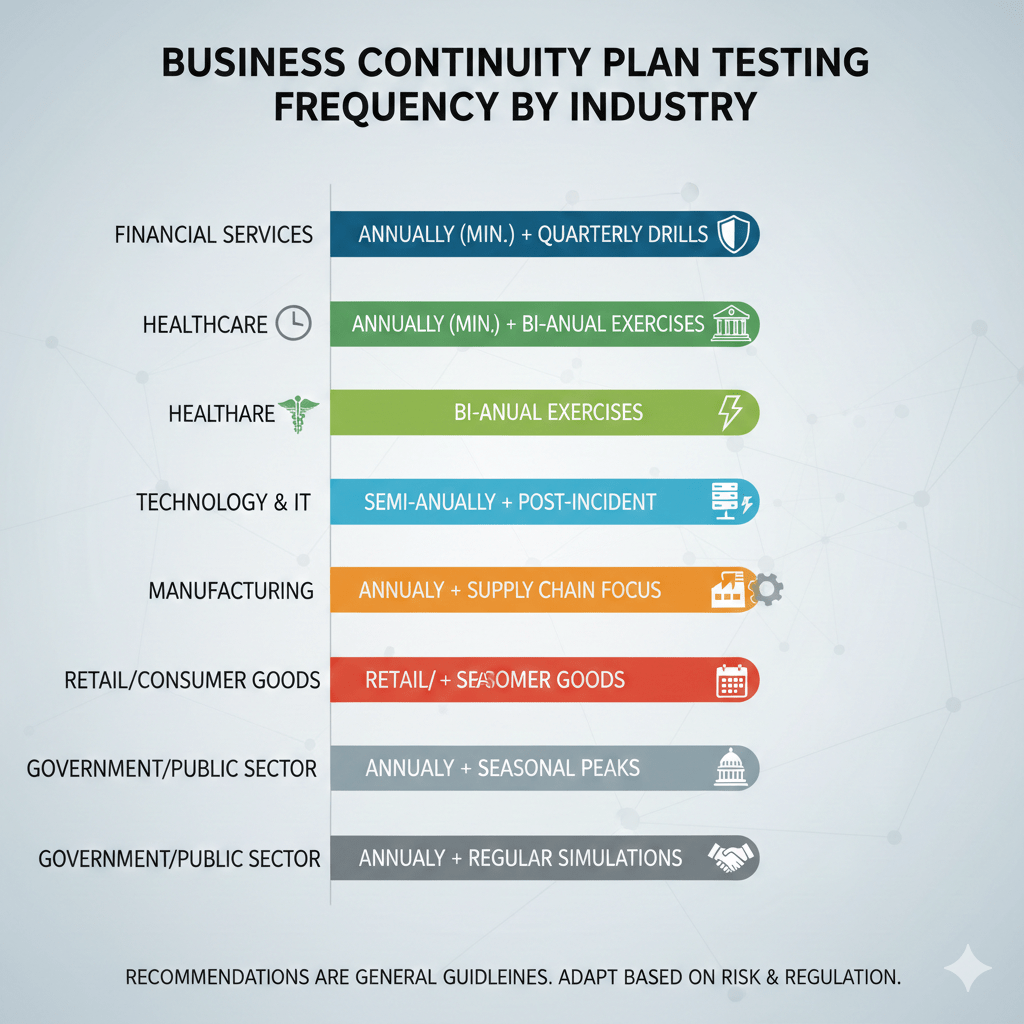
Check your regulator’s handbook — most now require documented proof of regular testing.
Types of Business Continuity Testing Methods (From Simple to Advanced)
Choose the right tool for the job. Mix these throughout your business continuity plan testing cycle:
- Walkthrough / Document Review
- Quick meeting to confirm contact lists, procedures, and recovery steps are current.
- Time: 1–2 hours. Cost: almost zero.
- Tabletop Exercise
- The team sits around a table and talks through a scenario step-by-step.
- Great for training new staff and spotting logic gaps.
- Component / Functional Test
- Test one piece (e.g., backup restoration, failover to secondary site, call-tree activation).
- Usually done twice a year.
- Integrated / Parallel Test
- Run recovery systems alongside live systems without cutting over.
- Safe way to measure real recovery times.
- Full Interruption / Cutover Test
- Actually switch to backup systems and run the business from the recovery site.
- Most realistic — and most expensive. Do this every 2–3 years.
Use a business continuity testing checklist after every exercise to capture lessons learned.
Step-by-Step BCP Testing Best Practices
- Schedule tests in advance and put them on the company calendar.
- Define clear objectives (“Can we restore critical applications in under 4 hours?”).
- Involve real decision-makers — not just the BCP team alone.
- Simulate realistic scenarios (ransomware, flood, cloud outage).
- Time every recovery step and document results.
- Write an after-action report within two weeks.
- Update the plan immediately based on findings.
- Share a short executive summary with leadership.
Pro tip: Treat testing like fire drills — routine, expected, and improving every time.
Real-World Examples That Prove Regular Testing Saves Companies
- Target (2013 data breach): Poor testing of payment-system failover contributed to massive losses.
- Maersk (2017 NotPetya attack): Because they had tested their BCP thoroughly, they recovered in 10 days while competitors took months.
- UK bank (2022): Failed a regulator-mandated disaster recovery plan testing frequency audit → £50 million fine.
These stories show why frequency of business continuity drills directly affects survival.
How to Build Your Business Continuity Plan Testing Cycle (Free Template)
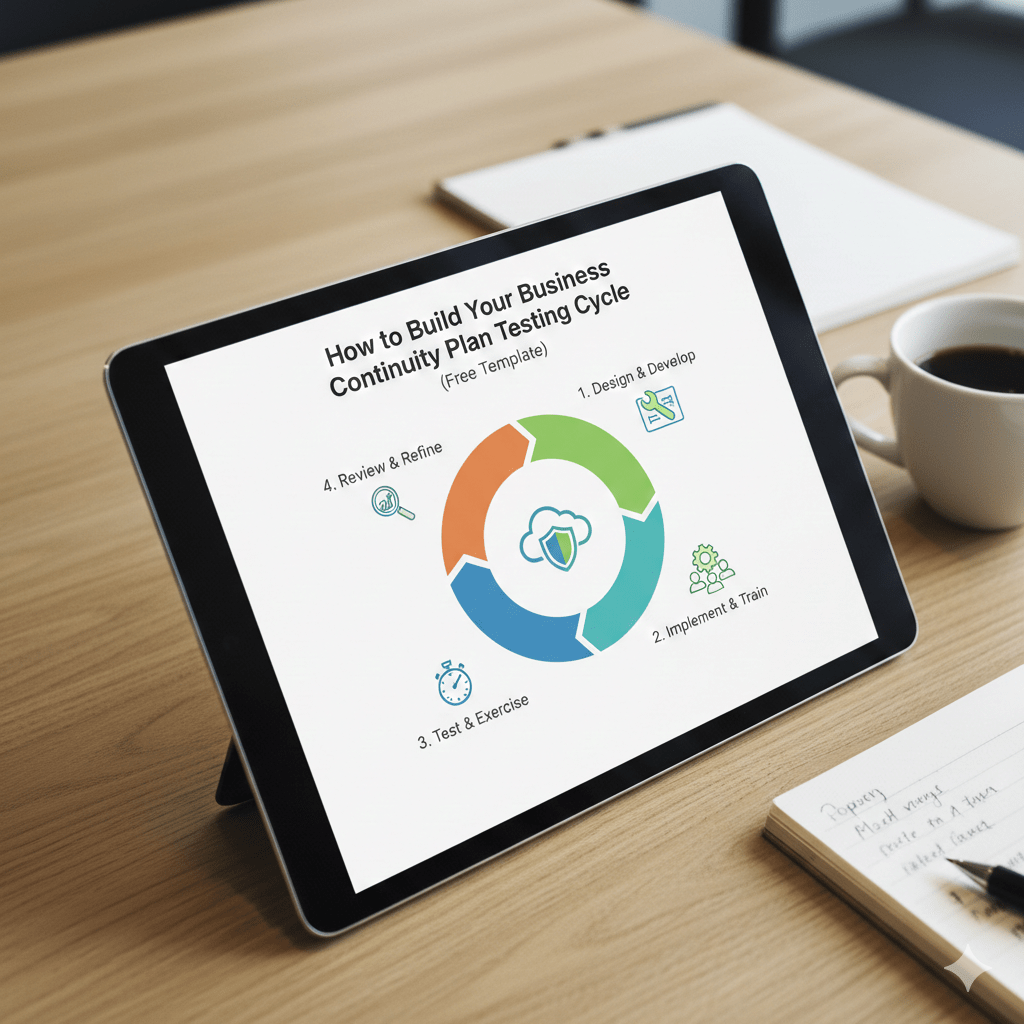
| Quarter | Activity | Type |
| Q1 | Annual full plan review + tabletop exercise | Review + Tabletop |
| Q2 | Component test (e.g., backup restore from backup) | Functional |
| Q3 | Component test (e.g., alternate site failover) | Functional |
| Q4 | Mini-tabletop + checklist validation | Light review1 |
| Ongoing | Test immediately after any major change | Trigger-based |
Download a ready-made calendar from LogicManager’s guide on how often a BCP should be reviewed or DataGuard’s testing blog here.
Common Mistakes That Make Testing Worthless
- Testing only IT — forgetting people and process.
- Using the same scenario every year (attackers and disasters evolve!).
- Skipping the after-action report or updates.
- Treating testing as a “check-the-box” exercise instead of real learning.
Avoid these and your business continuity readiness testing will actually protect the company.
FAQs – Quick Answers for Busy Professionals
How often should a business continuity plan be tested at minimum?
At least once per year with a real exercise (tabletop or functional) + after every major change (new system, office move, regulation update, merger, etc.).
What is the difference between “review” and “test”?
- Review = check if documents, contacts, and procedures are still correct (do this annually).
- Test = actually run an exercise to see if the plan works in practice (tabletop, component, or full simulation).
How often do you test BCP in banking or financial services?
Regulators (FFIEC, FDIC, ECB) usually require quarterly component tests + annual integrated or full tests2.
How often do you review business continuity plan documents?
Annually at minimum and within 30–60 days of any significant change.
Do tabletop exercises count as real BCP testing for auditors?
Yes. ISO 22301, NIST, HIPAA, and most regulators accept tabletops as valid business continuity plan exercises when properly documented.
What is the recommended frequency of business continuity drills?
- Tabletop or walkthrough: every 6–12 months
- Functional/component tests: twice per year
- Full interruption/cutover test: every 2–3 years (annually if you are high-risk)
How often should disaster recovery plan testing frequency be for IT systems?
Most standards require at least quarterly backup restoration tests and annual failover tests for critical systems.
In Conclusion – Make Testing a Habit, Not a Headache
How often should a business continuity plan be tested? At least annually — and always after major changes. Combine quarterly component tests, semi-annual tabletops, and a full simulation every 2–3 years for most organizations. High-risk or heavily regulated companies should test more often.
When you treat BCP testing best practices as routine maintenance instead of a once-in-a-while chore, you turn paper plans into real resilience3. Your people get confident, your regulators stay happy, and your business survives the unexpected.
What is your current testing schedule — and when was the last time you ran a real drill? Drop your experience in the comments below. Let’s keep each other prepared!
References & Further Reading
- Arcserve – “How Often Should a Business Continuity Plan Be Reviewed?” – arcserve.com/blog/how-often-should-business-continuity-plan-be-reviewed (Detailed testing-type schedule loved by IT and operations teams) ↩︎
- DataGuard – “How Often Should a BCP Be Tested?” – dataguard.com/blog/how-often-should-bcp-be-tested/ (Practical compliance-focused advice with regulatory references) ↩︎
- LogicManager – “How Often Should a BCP Be Reviewed?” – logicmanager.com/resources/business-continuity/how-often-should-a-bcp-be-reviewed/ (Excellent strategic overview for executives and risk managers) ↩︎

