
Many organizations face unexpected disruptions, from cyberattacks to natural disasters. But do you know the difference between business continuity plan and disaster recovery? These two concepts often get mixed up, yet they play distinct roles in keeping your business running smoothly. A business continuity plan focuses on maintaining operations during a crisis, while a disaster recovery plan targets restoring IT systems after an event. Professionals in risk, IT, and business management need to grasp this distinction to build resilient strategies. In this guide, we break it down simply, with actionable steps and real-world insights.
What Is a Business Continuity Plan?
Experts define a business continuity plan as a roadmap that helps your organization keep essential functions going during and after a disruption. It covers the whole business, not just tech. You create it to minimize downtime and protect revenue.
Think of it this way: A business continuity plan definition includes identifying risks, like power outages or supply chain breaks, and outlining steps to handle them. For example, if a flood hits your office, the plan might shift work to remote setups or backup sites.
Key elements include:
- Risk assessment: Spot potential threats.
- Business impact analysis: Figure out what hurts most if stopped.
- Recovery strategies: Set ways to keep going, like cross-training staff.
Statistics show why this matters. In 2025, downtime costs small businesses around $50,000 per hour, per Erwood Group reports. Larger firms face over $5 million. A solid plan cuts these losses.
Business leaders use business continuity planning to align teams. It ties into business continuity management, which oversees ongoing updates. For instance, in healthcare, plans ensure patient care continues without breaks.
What Is a Disaster Recovery Plan?
A disaster recovery plan zeros in on IT recovery after a crisis. It restores data, systems, and networks quickly. The disaster recovery plan definition emphasizes tech-focused steps, like backups and failover systems.
You build it around metrics such as Recovery Time Objective (RTO) – how fast to recover – and Recovery Point Objective (RPO) – how much data you can lose. For example, if ransomware strikes, the plan guides data restoration from backups.
Core components:
- Data backup: Regular copies of files.
- Testing: Simulate disasters to check readiness.
- Vendor partnerships: Work with cloud providers for quick restores.
IT managers rely on disaster recovery planning to protect infrastructure. In manufacturing, where unplanned downtime costs $50 billion yearly (Arda Cards), these plans save big. They fit into broader disaster recovery strategies, like hybrid cloud setups.
Difference Between Business Continuity Plan and Disaster Recovery: Breaking It Down
The main difference between business continuity plan and disaster recovery lies in scope and focus. Business continuity vs disaster recovery compares a holistic approach to a targeted one.
Business continuity plan vs disaster recovery plan:
- BCP covers all operations; DRP focuses on IT.
- BCP prevents stops; DRP fixes after damage.
- BCP involves everyone; DRP mainly IT teams.
In IT disaster recovery vs business continuity, DR is often a subset. BCP might include DR, but not vice versa. For example, during a cyberattack, BCP handles customer communications, while DR restores servers.
Difference between BCP and DRP also shows in timelines. BCP aims for ongoing ops; DR targets quick recovery, often within hours.
Professionals in business continuity risk management see BCP as proactive. It builds resilience. DR, part of the disaster recovery framework, is reactive.
Real case: During Hurricane Sandy, firms with strong BCP kept remote work flowing, while DR helped rebuild data centers.
Why Understand the Business Continuity and Disaster Recovery Differences?
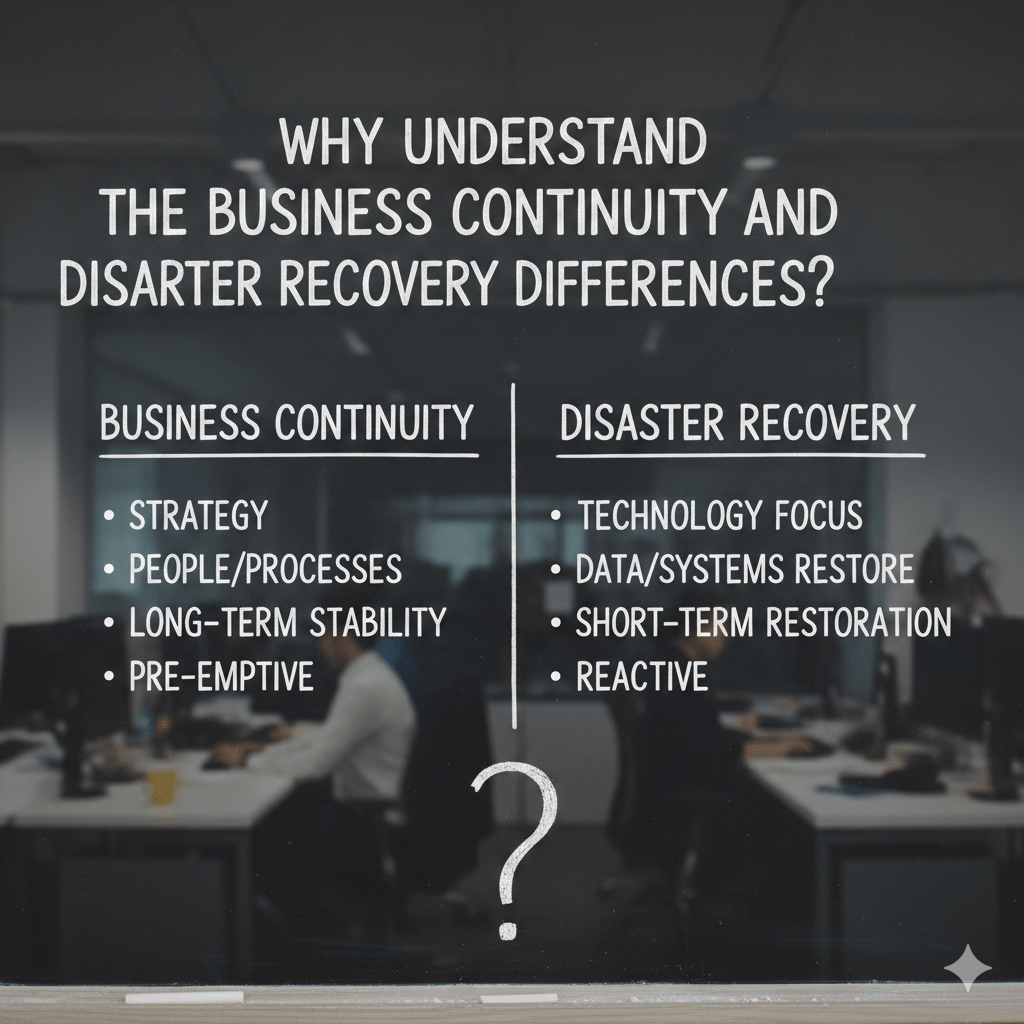
Grasping business continuity and disaster recovery differences helps you avoid costly mistakes. Disruptions hit 98% of organizations with over $100,000 per hour in losses, says Site Quality.
The importance of a business continuity plan? It maintains trust and revenue. Without it, customers flee – up to 40% never return after major downtime.
Disaster recovery best practices ensure quick IT rebounds, cutting financial hits. Oxford Economics pegs average downtime at $540,000 per hour.
For executives, these plans meet compliance in finance or healthcare. They reduce risks from cyberattacks, which rose 20% in 2025.
In short, they protect your bottom line and reputation.
Cultural and Strategic Impacts
Business continuity management fosters a resilient culture. Teams train for scenarios, boosting morale.
Disaster recovery vs business continuity in IT highlights strategy. IT leads DR, but business execs own BC.
Link this to starting your venture: Learn how to start a small business to integrate these from day one.
How to Create a Business Continuity Plan
You start how to create a business continuity plan with a team. Gather risk managers, IT, and execs.
Steps:
- Assess risks: List threats like floods or hacks.
- Analyze impacts: Use BIA to rank critical functions.
- Develop strategies: Plan backups, like alternate suppliers.
- Document: Write clear procedures.
- Test: Run drills yearly.
Tips: Involve consultants for objectivity. Update after changes, like new tech.
For examples, see business continuity plan examples from UCF, which outline simple templates1.
Tie to funding: Check startup funding options for first-time entrepreneurs to budget for planning.
How to Create a Disaster Recovery Plan
How to create a disaster recovery plan begins with IT inventory. List all systems and data.
Key steps:
- Define objectives: Set RTO and RPO.
- Backup data: Use cloud for offsite storage.
- Outline recovery: Step-by-step restore processes.
- Train staff: Ensure IT knows roles.
- Test regularly: Disaster recovery testing quarterly.
Best practice: Use automation for faster restores. According to IBM, this cuts recovery time by 50%.
For small firms, start simple: See how to manage cash flow in a small business to afford tools.
Best Practices for Implementation
Follow these for success.
For BCP:
- Involve all departments.
- Communicate clearly.
- Review annually.
For DR:
- Prioritize critical apps.
- Use multi-cloud.
- Monitor threats.
From BCM Institute, integrate DR into BC for seamless ops2.
Enhance with AI: Explore best AI tools for small business productivity.
Real-World Examples and Case Studies
Look at business continuity plan examples: A bank used BCP during a power outage, switching to generators and remote access, losing zero transactions.
Disaster recovery plan examples: After a fire, a retailer restored data from backups in four hours, per Atlassian.
In BCP and DRP in IT, tech firms like AWS combine them for 99.99% uptime.
Global view: See world economy impacts from disruptions.
For startups: Avoid pitfalls with why 90 of startups fail and how to avoid it.
The Role in Risk Management and Compliance
The business continuity planning process ties to risk frameworks. Identify, assess, mitigate.
In regulated sectors, plans ensure compliance, avoiding fines.
Disaster recovery strategies include redundancies, like mirrored servers.
For women-led businesses: Address challenges faced by women entrepreneurs in business.
Integrating with Other Business Strategies
Link to marketing: Use what is marketing and how it helps a business.
For finance: See private equity vs venture capital.
Eco-friendly angle: sustainable packaging ideas for small businesses.
Challenges and Solutions
Common issues: Lack of buy-in, outdated plans.
Solutions: Train regularly, use software.
For students: entrepreneurship opportunities for high school students.
FAQs: Common Questions Answered
What is the main difference between business continuity plan and disaster recovery?
The difference between business continuity plan and disaster recovery is in focus. A business continuity plan (BCP) keeps the entire organization running during a crisis. A disaster recovery plan (DRP) restores IT systems after the event.
What does business continuity plan definition mean?
The business continuity plan definition is a strategy to maintain critical operations amid disruptions like storms or supply issues. It covers people, processes, and tools across the business.
What is the disaster recovery plan definition?
The disaster recovery plan definition refers to steps for recovering IT infrastructure, data, and apps post-disaster, such as cyberattacks or hardware failures.
How do business continuity vs disaster recovery compare in scope?
Business continuity vs disaster recovery shows BCP as broad and proactive, while DR is narrow and reactive, mainly for tech.
What is a business continuity plan vs disaster recovery plan in practice?
In business continuity plan vs disaster recovery plan, BCP might shift staff to remote work during a pandemic. DRP restores servers after a ransomware attack.
How does the difference between BCP and DRP affect planning?
The difference between BCP and DRP means BCP involves all teams for ongoing ops. DRP centers on IT with metrics like RTO.
What is business continuity planning?
Business continuity planning is the process of creating and updating a BCP through risk assessments and tests.
What does disaster recovery planning involve?
Disaster recovery planning includes backups, recovery steps, and regular disaster recovery testing.
How do IT disaster recovery vs business continuity differ?
IT disaster recovery vs business continuity highlights DR as IT-specific, while BC includes non-tech elements like communications.
Conclusion: Building Resilience for Tomorrow
In summary, the difference between business continuity plan and disaster recovery boils down to breadth versus depth – BCP safeguards your entire operation3, while DR rebuilds IT foundations. By mastering business continuity planning and disaster recovery planning, you minimize risks, protect assets, and ensure long-term success. Implement these with clear steps, regular tests, and team involvement for reassuring stability.
What challenges have you faced in your business continuity management or disaster recovery framework? Share below to help others.
References
- UCF: Business Continuity vs. Disaster Recovery – Educational breakdown; ideal for students in business/IT programs. (Accessed Dec 2025). Targets learners and executives for strategic insights. ↩︎
- BCM Institute: What is the Difference Between Disaster Recovery and Business Continuity – Focuses on definitions for certification; suits continuity planners. (Accessed Dec 2025). Draws certification seekers in BCM/DR. ↩︎
- IBM: Business Continuity vs. Disaster Recovery Plan – Detailed on RTO/RPO; targets IT managers in enterprises. (Accessed Dec 2025). Appeals to technical leaders handling infrastructure. ↩︎

