
Every day, companies face risks that can stop normal work. A fire, a ransomware attack, a flood, or even a simple power cut can cost millions in hours. This is exactly why understanding the importance of business continuity and disaster recovery planning has never been greater. Smart leaders now treat business continuity planning (BCP) and disaster recovery planning (DRP) as must-have insurance for the whole organization — not just the IT team.

When a crisis hits, companies with solid business continuity and disaster recovery (BC/DR) plans get back to work fast. Those without plans lose money, customers, and sometimes the entire business. In this guide, we explain everything in plain language: what these plans are, why they matter, who needs them, and simple steps to build yours today.
What Are Business Continuity and Disaster Recovery? Simple Definitions
Business Continuity Planning (BCP) keeps the whole company running (or quickly restarts) during and after a problem. It covers people, buildings, suppliers, and customers.
Disaster Recovery Planning (DRP) is the technical part of the bigger plan. It focuses on bringing back computers, servers, apps, and data after something goes wrong.
Together they form business continuity and disaster recovery (BC/DR) — your safety net for business resilience.
Why the Importance of Business Continuity and Disaster Recovery Planning Is Growing Every Year
Real numbers show the cost of doing nothing:
- 93% of companies without a tested disaster recovery strategy that suffer a major data disaster are out of business within one year (U.S. National Archives).
- The average cost of one hour of downtime in 2024–2025 is $300,000–$500,000 for medium and large firms (Gartner).
- Ransomware attacks rose 105% year-over-year in 2024 (IBM X-Force).
- 71% of companies hit by ransomware had a plan, but only 31% of those plans actually worked well (Sophos).
These numbers prove that just having a document on a shelf is not enough. You need a living, tested continuity of operations plan (COOP) and IT disaster recovery program.
Who Needs These Plans? (Spoiler: Everyone)
| Audience | Why They Care Most |
| CEOs & Business Owners | Protect revenue, brand, and long-term survival |
| Risk & Compliance Teams | Meet regulatory compliance and business continuity rules (GDPR, HIPAA, SOC 2, ISO 27001 |
| IT & Cybersecurity Teams | Fast data backup and recovery, IT system resilience, cyber disaster recovery |
| Operations Managers | Keep supply chain, staff, and customers connected |
| Startups & Small Businesses | One bad day can end the company — plans give a second chance |
Even solo entrepreneurs and side-hustle owners benefit from a simple one-page plan.
Key Benefits You Gain from Strong Plans
- Save money – Reduce downtime and avoid huge losses.
- Keep customers happy – Deliver service even during crises.
- Stay legal Many industries now require proven business continuity and disaster recovery programs.
- Protect reputation – Companies that recover fast are seen as trustworthy.
- Get cheaper insurance – Many insurers lower premiums for tested plans.
- Sleep better at night – You know the business can survive almost anything.
The Main Parts Every Plan Needs
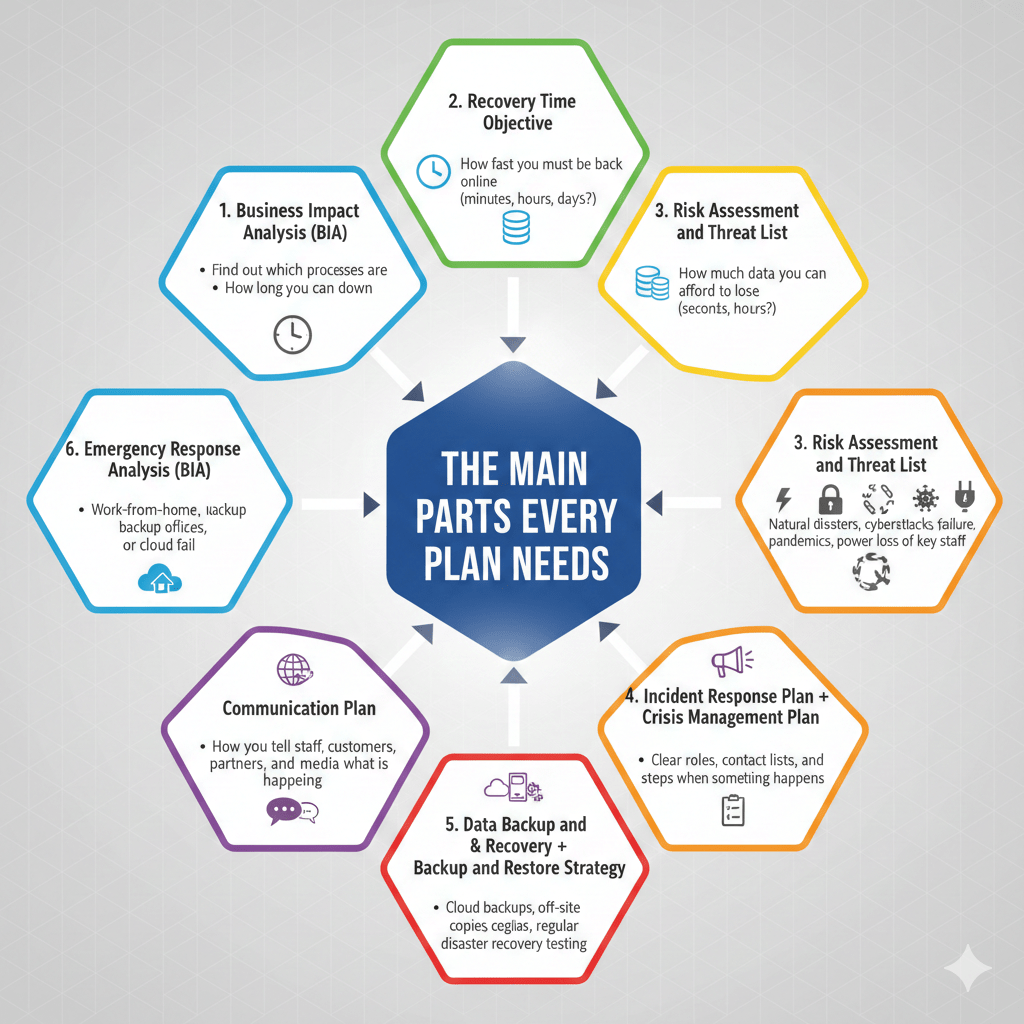
1. Business Impact Analysis (BIA)
Find out which processes are most important and how long you can be down1.
2. Recovery Time Objective (RTO) and Recovery Point Objective (RPO)
- RTO How fast you must be back online (minutes, hours, days?).
- RPO How much data you can afford to lose (seconds, hours?).
3. Risk Assessment and Threat List
Natural disasters, cyberattacks, supplier failure, pandemics, power loss of key staff.
4. Incident Response Plan + Crisis Management Plan
Clear roles, contact lists, and first steps when something happens.
5. Data Backup and Recovery + Backup and Restore Strategy
Cloud backups, off-site copies, regular disaster recovery testing.
6. Communication Plan
How you tell staff, customers, partners, and media what is happening.
7. Emergency Response Planning and Alternate Sites
Work-from-home rules, backup offices, or cloud failover.
Real-Life Examples That Show Why Plans Work
- Target (2013 data breach) Took weeks to recover partly because IT disaster recovery was weak.
- Maersk (2017 NotPetya attack) Lost $300 million but survived because a single office in Ghana had power and a clean backup. Their disaster recovery solutions saved the company.
- Texas hospitals during the 2021 winter storm Many stayed open because they had fuel contracts and backup generators in their continuity risk assessment.
How to Build Your Own Plan – Simple 8-Step Roadmap
- Get leadership buy-in (this is the most important step).
- Form a small team from IT, operations, HR, and legal.
- Run a business impact analysis (BIA).
- Write a clear recovery time objective (RTO) and recovery point objective (RPO) for each system.
- Choose disaster recovery services or in-house tools (cloud, tapes, hybrid).
- Document every step in an incident response plan and crisis management plan.
- Train everyone and run tabletop exercises twice a year.
- Test, update, repeat — plans get old fast.
Helpful resource: Read IBM’s complete guide on business continuity and disaster recovery for technical templates.
Common Mistakes That Make Plans Fail
- Thinking “It won’t happen to us.”
- Writing a 200-page plan that nobody reads.
- Never testing the plan (51% of companies never test – Veeam 2024 report).
- Forgetting third-party suppliers in the continuity of operations plan (COOP).
- Keeping only one copy of backups in the same building.
Special Focus: Cyber Disaster Recovery Is Now the #1 Reason Companies Build Plans
In 2025, ransomware and phishing are the fastest-growing threats. A strong cyber disaster recovery plan now includes:
- Immutable (unchangeable) cloud backups
- Zero-trust network access
- Offline “golden copies” of critical data
- Pre-built runbooks for ransomware incidents
Learn more in Scrut’s practical post on [building a business continuity and disaster recovery plan](scrut.io/post/business-continuity-disaster-recovery-plan].
How Startups and Small Businesses Can Start Cheap and Fast
You do not need a big budget:
- Use free templates from Ready.gov or ISO 22301 checklists.
- Back up data to two cheap cloud services (Google Drive + Microsoft 365).
- Write a simple one-page incident response plan and share it with the team.
- Practice once a year with a 30-minute “what-if” meeting.

Read our related guides:
- How to write a business plan (includes a section on risk)
- Why 90% of startups fail – and how to avoid it (downtime is a top killer)
- How to manage cash flow in a small business (downtime kills cash fast)
Disaster Recovery Testing – The Step Most Companies Skip (But Shouldn’t)
Testing is like a fire drill for your company. Do these four tests every year2:
- Tabletop exercise (talk through a fake crisis).
- Walk-through of the written plan.
- Partial failover test (switch to backup systems).
- Full cut-over test (run completely on backup for a few hours).
Companies that test recover 62% faster (Gartner).
FAQs – Quick Answers for Busy Leaders
What exactly is the difference between BCP and DRP?
Business continuity planning (BCP) keeps the whole company running (people, suppliers, customers, money).
Disaster recovery planning (DRP) is the technical part that gets computers, apps, and data back online fast.
Do small businesses and startups really need these plans?
Yes! 40– 40% of small businesses never reopen after a major disaster (FEMA). Even a 2-day outage can kill cash flow. A simple one-page plan is enough to start.
How much does a good plan cost?
For small companies: $0–$5,000 per year (mostly cloud backups + a little consulting).
For medium/large firms: $20,000–$200,000+ depending on size and industry. The cost of NOT having one is 10–100× higher.
Is business insurance the same as a continuity plan?
No. Insurance pays you money weeks or months later. A business continuity and disaster recovery plan keeps you earning money during the crisis.
How long should my RTO and RPO be?
Examples most companies use in 2025:
- Email & CRM → RTO 4 hours, RPO 1 hour
- Website/e-commerce → RTO 1 hour, RPO 5–15 minutes
- Payroll system → RTO 24 hours, RPO 0 (no data loss allowed)
In Conclusion – Make the Importance of Business Continuity and Disaster Recovery Planning Your Competitive Edge
The importance of business continuity and disaster recovery planning is simple3: it is the difference between a short pause and going out of business. In 2025, threats are faster and bigger than ever, but so are the tools to fight them. A clear, tested business continuity planning (BCP) and disaster recovery strategy protects your people, your customers, your money, and your future.
Start small, test often, and keep the plan alive. Your company — and everyone who depends on it — will thank you when the unexpected happens.
What is the biggest risk your business faces right now, and have you planned for it yet? Drop your thoughts in the comments — let’s keep the conversation going.
References & Further Reading
- IBM – “Business Continuity and Disaster Recovery” –.ibm.com/think/topics/business-continuity-disaster-recovery ↩︎
- Scrut.io – “Business Continuity & Disaster Recovery Plan” – scrut.io/post/business-continuity-disaster-recovery-plan Excellent templates and checklists loved by IT and compliance teams. ↩︎
- MLT Aikins – “The Importance of a Business Continuity and Disaster Recovery Plan” – mltaikins.com/insights/the-importance-of-a-business-continuity-and-disaster-recovery-plan/ Legal and regulatory view, perfect for risk officers. ↩︎

