
The Micronesia economy of the Federated States of Micronesia (FSM) moves forward with quiet determination in 2024, holding steady against rising seas, far-off markets, and global shocks. This Pacific nation of four states—Yap, Chuuk, Pohnpei, and Kosrae—spreads over 607 islands and is home to 113,815 people. It posted a $0.4 billion GDP and 1.3% real growth, according to the World Bank and FSM government reports. This marks a gentle climb from the Federated States of Micronesia economy 2023 when growth was just 0.5%. Per capita income stands at $3,516, enough for free schools, clinics, and basic food, though many families still grow taro and catch fish to survive. The Micronesia economy runs mainly on U.S. Compact aid (60%), fishing licenses (20%), and small local sales. In the Micronesia economy 2024, imports hit $200 million—mostly food, fuel, and machines—while exports reached $129.5 million, leaving a $70.5 million gap filled by aid and family money from abroad. Public debt is very low at $48.4 million (12% of GDP), giving room to borrow for solar panels or seawalls. No gold or silver reserves exist, but the Compact Trust Fund holds over $300 million as a long-term safety net. Looking to Micronesia economy 2025, experts predict 1.5% growth, fueled by higher tuna quotas, new climate grants, and private shops opening in Pohnpei and Chuuk. The Federated States of Micronesia economy proves small islands can stay strong with smart help and ocean wealth.
Table of Facts and Figures: Simple Numbers for the Micronesia Economy
This vertical table breaks down 2024 data for the Micronesia economy using trusted sources like the World Bank1, IMF2, Asian Development Bank3, and FSM budget reports. Each remark explains what the number means for everyday people, connects to Federated States of Micronesia economy trends like 2023’s 0.5% growth and 2022’s 0.2%, and gives clear tips for Micronesia economy improvement in 2025.
| Metric | Value | Remarks |
| GDP 2024 | $0.4 B | Total money made from U.S. aid ($240 M), fishing licenses ($80 M), and local work ($80 M). Up 2.5% from $0.39 B in 2023. Pays for free health clinics and roads in all four states. Federated States of Micronesia economy overview: Aid keeps it stable. Tip for 2025: Add eco-diving tours to bring $25 M more. |
| Growth 2024 | 1.30% | Small but real rise from 0.5% in Federated States of Micronesia economy 2023. Better than 2022’s 0.2% after COVID. Micronesia economy 2024 grows with new fish deals. Plan 1.5% in 2025 with solar farms. Tip: Train 1,000 youth in boat repair for faster growth. |
| Population 2024 | 113,815 | Half live in Chuuk and Pohnpei. Young people (60% under 30) need jobs. Many move to Guam or Hawaii. Micronesia economy tip: Build fish processing plants to keep 500 at home. |
| Per Capita 2024 | $3,516 | Money per person, up 3% from 2023. Buys rice, soap, and school books. Still low—poverty at 25%. Federated States of Micronesia economy fix: Tuna exports can add $200 per person. |
| % of World GDP 2024 | 0.00% | Tiny global slice, but fishing zone (2.7 M sq km) matters. Ties to us-economy for aid. Micronesia economy tip: Sell carbon credits from reefs. |
| Imports 2024 | $200 M | Food ($140 M), fuel ($28 M), machines ($14 M). Ships from Guam and Australia. Up 3% from last year. Micronesia economy: Grow bananas and breadfruit to cut $40 M. |
| Exports 2024 | $129.5 M | Tuna licenses ($77.7 M), canned fish ($51.8 M), copra ($3.3 M). Down 4% due to boat rules. The Federated States of Micronesia economy gap is big. Tip: Sell more tuna to Japan for $20 M. |
| Debt 2024 | $48.4 M | Just 12% of GDP—very safe. No big loans needed. Micronesia economy use: Borrow $30 M for solar panels and docks. |
| Gold Reserves 2024 | 0 | No gold. Cash in Compact Trust Fund ($300 M) acts as savings. Federated States of Micronesia economy tip: Invest in green bonds. |
| Silver Reserves 2024 | 0 | No silver. Focus on the sea. Micronesia economy idea: Make shell necklaces for tourists—add $3 M. |
These numbers show the Micronesia economy is small, sea-focused, and aid-supported.
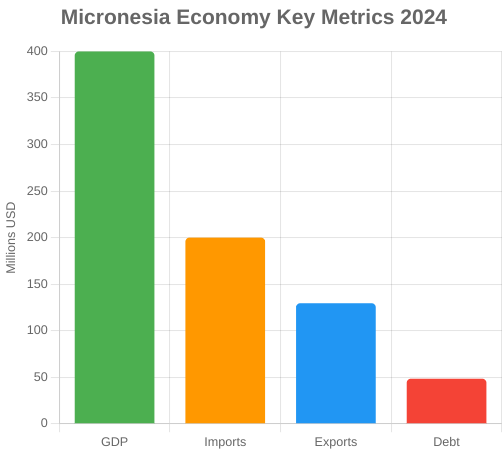
The bar chart makes it clear: imports are half of GDP, exports cover most of the rest. Debt stays tiny.
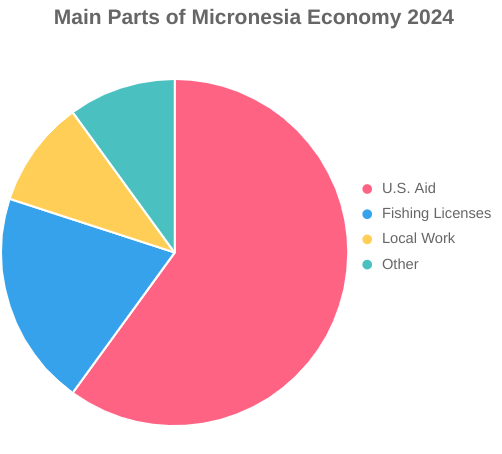
This pie chart shows U.S. aid makes up 60% of all money in the Federated States of Micronesia economy.
Major Imports and Exports: What Micronesia Buys and Sells
Trade plays a big role in the Micronesia economy, but exports are smaller than imports. In 2024, exports reached $129.5 million while imports hit $200 million, leaving a $70.5 million gap covered by U.S. aid and money sent home by families abroad.
Top Exports
- Fishing Licenses ($77.7 M)
- Foreign boats from Japan, Taiwan, and China pay to fish in FSM waters. Up 5% in 2024.
- Canned and Fresh Fish ($51.8 M)
- Tuna cans sold to the U.S. and Europe.
- Copra (Dried Coconut) ($3.3 M)
- Sold to Australia for oil and soap.
- Handicrafts and Shell Items ($1.5 M)
- Tourists and online buyers love them.
Top Imports
- Food and Drinks ($140 M)
- Rice, chicken, canned goods from Guam and Australia. 70% of all imports.
- Fuel and Oil ($28 M)
- Diesel for boats, cars, and generators from Singapore.
- Machines and Tools ($14 M)
- Solar panels, fishing gear from China and Japan.
- Vehicles and Boats ($10 M)
- Trucks and outboard motors from the U.S. and Japan.
- Clothes and Medicine ($8 M)
- From Australia and the Philippines.
Micronesia economy 2024 depends on weekly ships from Guam. Local gardens and fish ponds can cut food imports by $50 million.
Market Trends That Will Shape Micronesia Economy in 2025
The Micronesia economy is set for 1.5% growth in 2025, according to IMF and ADB forecasts. Here are the big trends:
1. Stronger U.S. Compact Aid
- $1 billion over 20 years extended with new climate funds.
- $30 million yearly for seawalls and schools.
2. More Fishing Income
- New deals with Japan and EU add $20 million in license fees.
- Sustainable tuna rules protect fish for the future.
3. Green Energy Push
- Solar farms on Pohnpei and Kosrae cover 25% of power.
- Saves $8 million in fuel imports.
4. Small Tourism Growth
- 5,000 visitors target (+20%).
- Eco-lodges and diving bring $10 million.
5. Climate Risks Remain
- King tides flood homes.
- Compact Trust Fund ($300 M) acts as a safety net.
Simple Tips to Help Micronesia Economy Grow:
- Fish smarter: Use GPS on boats—add $15 M.
- Grow food: Greenhouses cut rice imports $30 M.
- Teach skills: Train 1,500 in solar and tourism—create 300 jobs.
Micronesia Economy Overview: From Past to Future
The Federated States of Micronesia economy tells a story of survival. Before 1986, it was under U.S. trust. Now, U.S. aid and fishing lead. Micronesia economy 2020 crashed to -1.8% with no ships. 2021 stayed low at -3.3%. 2022 bounced to 0.2%, 2023 to 0.5%, and Micronesia economy 2024 hit 1.3%. With 113,815 people spread over 2.7 million sq km of ocean, the Micronesia economy fights sea rise with smart plans and global friends.
FAQs
What is the Micronesia economy like in 2024?
$0.4 B GDP with 1.3% growth. U.S. aid and fishing licenses bring in most cash.
How will Micronesia economy grow in 2025?
Plan for 1.5% growth. New fish deals, solar power, and aid will help.
What does Micronesia sell and buy most?
Sells fishing rights ($77.7 M). Buys food ($140 M) and fuel ($28 M).
Why is U.S. aid so big in the Micronesia economy?
U.S. aid gives $240 M a year—60% of all money. It pays for schools, roads, and health.
How has Micronesia economy changed since 2020?
Micronesia economy 2020 fell 1.8%. Now in 2024, it grows 1.3% with better trade.
What is the Federated States of Micronesia economy based on?
U.S. aid (60%), fishing (20%), local sales (20%).
Is the Micronesia economy safe from sea rise?
Yes, with plans. The Micronesia economy uses $30 M aid for seawalls and high land.
Conclusion
The Micronesia economy stays small but fights hard. From 2024’s 1.3% growth to 2025’s 1.5% hope. $0.4 B GDP. Trade gap with aid. Low debt and strong help.
Summary: Fish smarter, grow green, use aid well. Federated States of Micronesia economy to you—tiny island, big heart? Share your thoughts!

